


What is hair loss?
Hair loss in men
- The causes of hair loss
- Drug-induced hair loss
- Hair loss and the pill
- Hair loss and genetics
- Hair loss and hormones
- What is traction alopecia?
- Androgenetic alopecia in women and men
- Secondary syphilis and hair loss
- Scarring alopecia
- Hair loss due to ringworm of the scalp
- Everything you need to know about seasonal hair loss
- Hair loss and Covid
- Pregnancy and hair loss: everything you need to know
- Spot baldness and hair loss
- Hair loss and fatigue
- Hair loss due to stress: reactional hair loss
- Hair loss: the impact of iron, zinc, vitamin D, C and B12 deficiencies
- Hair loss and menopause

Men are widely affected by a type of hair loss known as androgenetic alopecia. The most common form of this male alopecia is baldness, the cause of which is primarily hormonal.
What are the differences between hair loss in women and hair loss in men?
On a daily basis, hair loss affects men and women equally. The types of hair loss they experience, however, are different, as are the causes and consequences. In fact, androgenetic alopecia is more common in men (70% to 80% versus 29% to 42% for women*), whereas women are more widely affected by acute telogen effluvium and chronic telogen effluvium.
Alopecia in men is common and often appears between the ages of 30 and 40. That being said, it is not rare for this hormone-induced hair loss, which involves the androgen receptors found in the dermal papilla, to appear in younger patients.
It is interesting to note that hair loss in women is a condition that is heavily influenced by hormonal changes observed during the postpartum period and menopause. Specialists estimate that one-third, or even one-half, of women** will experience temporary hair loss following a pregnancy.
Characteristics of alopecia in young men
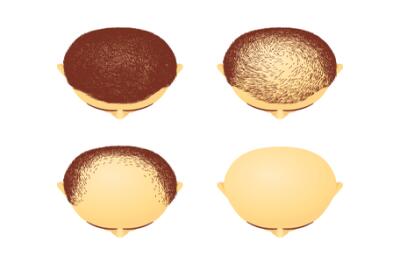 Androgenetic alopecia: definition
This medical and scientific term refers to diffuse hair loss that eventually leads to a reduction in hair density and whose origin is hormonal. Dihydrotestosterone (active metabolite of testosterone) stimulates the androgen receptors in the hair follicle. This results in the miniaturization of the hair follicle and the appearance of increasingly shorter, thinner hair.
Androgenetic alopecia: mechanism
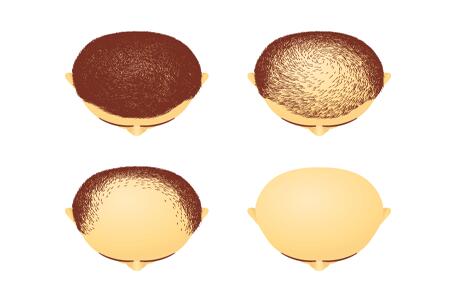
Baldness, which is the most common form of androgenetic alopecia in men, is characterized by episodes of diffuse hair loss. Its onset and appearance mechanism is nearly always the same: in this case, hair loss is observed on very specific areas, on the hairline and temples, before spreading to the rest of the scalp.
Often hereditary, this hair loss affects men both young and old. Today, health professionals continue to struggle to manage this condition, and this despite there being two medicinal treatments (minoxidil and finasteride) with proven efficacy.
* Source: Blume-Peytavi et al., 2011; Norwood, 1975.
** Source: Grover and Khurana, 2013.
Our specific formulas for hair loss
Solutions for all types of hair loss
- Anti-hair loss complement shampoo
ANAPHASE
Anti-hair loss complement shampooRevitalizes - Helps to strengthen - Prevents hair loss - Anti-hair loss and anchorage serum
ANAPHASE NEOPTIDE
Anti-hair loss and anchorage serumSlows down hair loss - Boost growth - Densifies hair - Volumises - Increases hair anchorage - Increases hair thickness - Food supplement
ANACAPS EXPERT
Food supplementHelps curb hair loss - Increases microcirculation - Provides strength and resistance

What is your kind of hair loss ?
Identify your hair loss type via our diagnosis test and discover the care routine adapted to your hair’s needs.
More information
- Discover Diffuse hair loss
What is hair loss?
Diffuse hair loss
- Discover The hair's life cycle
What is hair loss?
The hair's life cycle
- Discover Localized hair loss
What is hair loss?
Localized hair loss
- Discover Chronic hair loss
What is hair loss?
Chronic hair loss
- Discover Occasional or reactional hair loss
What is hair loss?
Occasional or reactional hair loss