
Causes of seborrheic dermatitis
- SUMMARY
- Seborrheic dermatitis
Seborrheic dermatitis and the microbiome
- What is seborrheic dermatitis?
- Seborrheic dermatitis on the torso
- Psoriasis or seborrheic dermatitis?
- Infant seborrheic dermatitis
- Eczema or seborrheic dermatitis?
- Seborrheic dermatitis on the face: causes and treatment
- Seborrheic dermatitis: scalp and hair loss
- Seborrheic dermatitis of the scalp: causes and treatments

Seborrheic dermatitis and the microbiome
Updated on , approved by our DUCRAY medical experts.
The skin is home to a living ecosystem known as the cutaneous microbiome. This is made up of billions of micro-organisms such as bacteria, yeast and even viruses. These tiny organisms play an essential role in the health of our skin, and researchers are increasingly interested in their impact on skin disorders.
So what is the link between seborrheic dermatitis and the skin’s microbiome? And can a probiotic/seborrheic dermatitis approach be considered as a complement to conventional treatments?
What is the microbiome?
The microbiome is a complex and dynamic ecosystem that lives within our bodies. It’s made up of billions of micro-organisms (bacteria, yeasts, viruses), genetic material and the substances they produce. This microscopic world lives mainly in our intestines, but also in the mouth, lungs, vagina and on our skin.
The skin microbiome is an essential part of our skin's surface. It’s made up of different micro-organisms, such as bacteria, yeast (a type of fungus), viruses and other small forms of life that coexist in balance to protect and maintain the our skin’s health. This skin microflora is not the same all over the body. It changes according to a number of factors, including temperature, humidity and the amount of sebum, as well as according to gender, age, diet, the skincare products we use, stress and much more.
The connection between healthy skin and the microbiome
Our skin's microbiome is made up mainly of two types of micro-organisms (1):
- Residents : These are the micro-organisms that live permanently on our skin, such as Corynebacteria, Propionibacteria and Staphylococci. They are also known as the "central microbiota". They are generally beneficial and help the skin restore its balance after a disturbance. This includes Malassezia yeast, found mostly on the scalp.
- Transients: nicknamed " tourists ”, these micro-organisms come from outside the body and do not stay on the skin for long.
Normally, these two groups live together without causing any problems. The skin is healthy.
From the point of view of bacteria, our skin can be compared to a medium for growth:
- The skin microbiome develops from birth and evolves throughout life.
- Its composition varies according to many factors, including genetics, age, diet, lifestyle and the region where we live.
- Different skin environments are home to specific microbial communities. For example, wetlands are dominated by Staphylococci and Corynebacteria, while sebum-rich areas are populated by Propionibacteria.
- These micro-organisms are not only found on the surface, but also in the deeper layers of the skin. They play a key role in immune responses and help to maintain healthy skin.
When this balance is disturbed (a state known as dysbiosis), certain micro-organisms can multiply to the detriment of others, which can lead to various skin problems. This can be caused by stress, the environment, certain medications, a hormonal imbalance, excessive alcohol consumption, dietary deficiencies, or the use of unsuitable cosmetic products that alter the pH of the skin (1).
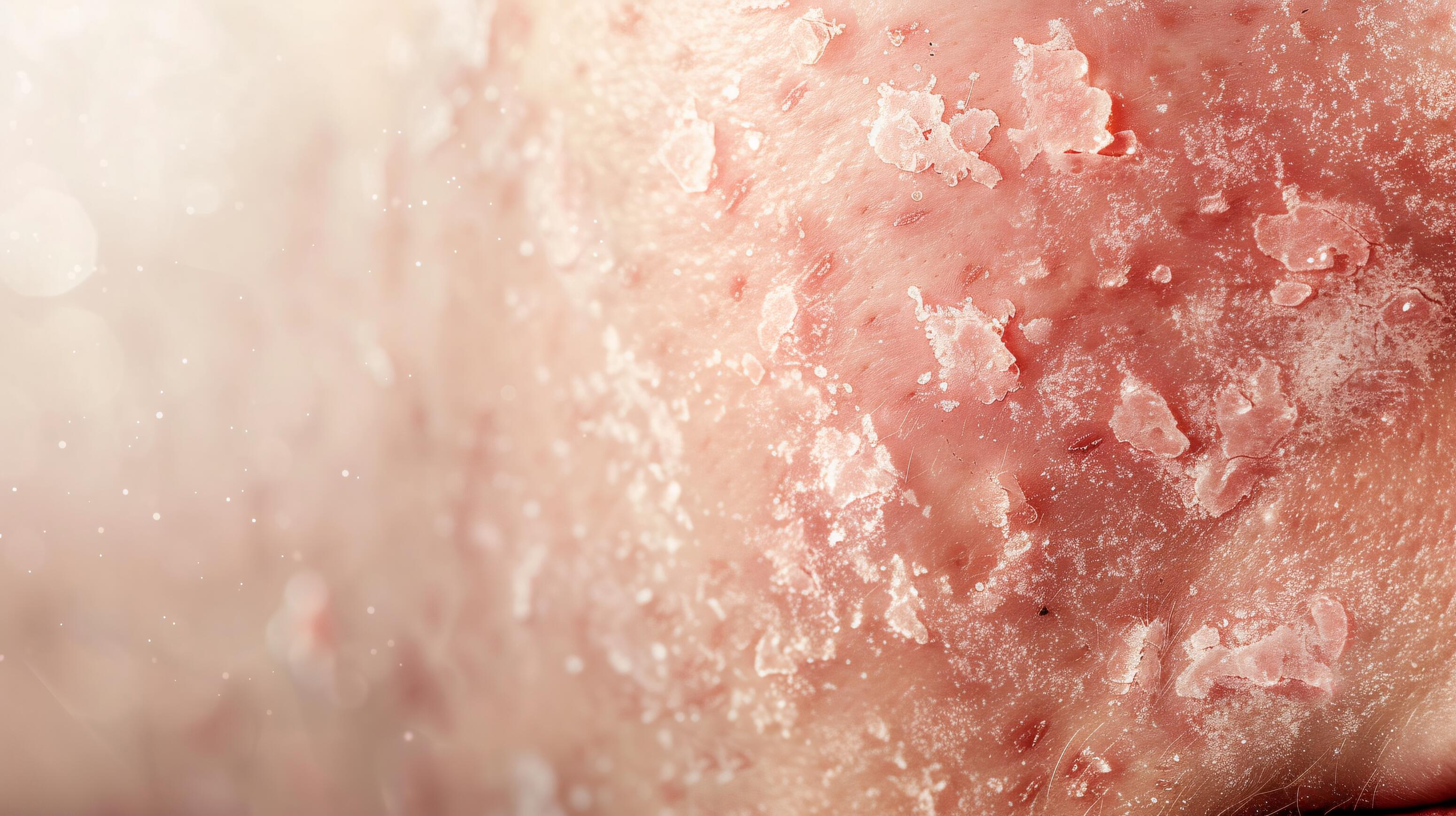
The microbiome and seborrheic dermatitis
One of the main causes of seborrheic dermatitis is the proliferation of a yeast called Malassezia. It is naturally present on the surface of the skin and forms part of the cutaneous microbiome.
There are currently fourteen different species of Malassezia, but those most often linked to skin problems such as seborrheic dermatitis are Malassezia Restricta and Malassezia Globosa (2).
These yeasts are generally harmless, but under certain conditions they can multiply and become problematic. If this happens, they can cause inflammation and redness of the skin.
To help rebalance the skin's microbiome, daily skincare treatments can be useful. They improve the skin's barrier function, reduce inflammation and limit flaking, which are all typical signs of seborrheic dermatitis. Standard treatments often include antifungal and antibacterial shampoos.
Research into the benefits of combining probiotics with seborrheic dermatitis is in progress (4). What's interesting is that these studies are showing that not only is the skin microbiome affected, but that many skin problems are also linked to imbalances in the intestinal microbiome (5).
Sources :
(1) Dréno B, Araviiskaia E, Berardesca E, Gontijo G, Sanchez Viera M, Xiang LF, Martin R, Bieber T. Microbiome in healthy skin, update for dermatologists. J Eur Acad Dermatol Venereol. 2016 Dec;30(12):2038-2047. doi: 10.1111/jdv.13965. Epub 2016 Oct 13. PMID: 27735094; PMCID: PMC6084363
(2) Zhijue Xu1,*, Zongxiu Wang2,*, Chao Yuan3,*, Xiaoping Liu3,*, Fang Yang1, Ting Wang2, Junling Wang2, Kenji Manabe4, Ou Qin3, Xuemin Wang3,†, Yan Zhang1 & Menghui Zhang1 ; Dandruff is associated with the conjoined interactions between host and microorganisms.
(3) Scientific RepoRts | 6:24877 | DOI: 10.1038/srep24877
(4) Habeebuddin M, Karnati RK, Shiroorkar PN, Nagaraja S, Asdaq SMB, Khalid Anwer M, Fattepur S. Topical Probiotics: More Than a Skin Deep. Pharmaceutics. 2022 Mar 3;14(3):557. doi: 10.3390/pharmaceutics14030557. PMID: 35335933; PMCID: PMC8955881.
(5) De Pessemier B, Grine L, Debaere M, Maes A, Paetzold B, Callewaert C. Gut-Skin Axis: Current Knowledge of the Interrelationship between Microbial Dysbiosis and Skin Conditions. Microorganisms. 2021 Feb 11;9(2):353. doi: 10.3390/microorganisms9020353. PMID: 33670115; PMCID: PMC7916842.
Read also
- Discover Seborrheic dermatitis and stress
Causes of seborrheic dermatitis
Seborrheic dermatitis and stress
Our targeted solutions for seborrheic dermatitis
Discover our complete range
- Anti-dandruff treatment shampoo
KELUAL DS ORIGINAL
Anti-dandruff treatment shampooEliminates severe dandruff - Eliminates dandruff after the first application* - Soothes itchiness* - Limits recurrences - Anti-scales cleansing gel
KELUAL DS
Anti-scales cleansing gelPurifies - Removes flakes - Soothes - Reduces redness


Our skincare routines
Irritated skin with redness and flakiness