
What is seborrheic dermatitis?
- SUMMARY
- Seborrheic dermatitis
Infant seborrheic dermatitis
- What is seborrheic dermatitis?
- Seborrheic dermatitis on the torso
- Psoriasis or seborrheic dermatitis?
- Infant seborrheic dermatitis
- Eczema or seborrheic dermatitis?
- Seborrheic dermatitis: scalp and hair loss
- Seborrheic dermatitis of the scalp: causes and treatments
- Seborrheic dermatitis on the face: causes and treatment

Infant seborrheic dermatitis
Updated on , approved by our DUCRAY medical experts.
Seborrheic dermatitis in infants, commonly known as baby dermatitis or “ cradle cap ", is a common skin condition: 70% of children under 3 months of age and 10% of children under 5 years of age are affected (1). It can appear as early as the 3rd or 4th week of life.
Does it only affect the scalp? Are there any other symptoms to look out for? What can be done about it? Find the answers in this article.
Areas affected by infant seborrheic dermatitis
Although cradle cap on the scalp is the most common form of seborrheic dermatitis in babies, there are actually three main types:
- Scalp dermatitis, more commonly known as cradle cap: this is the most common form of baby seborrheic dermatitis.
- Diaper rash.
- Dermatitis of skin fold lesions.
How can seborrheic dermatitis be prevented in babies?
Preventing seborrheic dermatitis in babies is difficult because its onset is linked to the presence of maternal hormones in the infant's body. These hormones, transmitted by the mother, are still present after birth. They activate the baby's sebaceous glands, increasing sebum production. This excess sebum creates a favourable environment for the proliferation of Malassezia yeast, leading to the formation of thick, yellowish crusts on the baby's scalp, commonly known as cradle cap.
Fortunately, nature has its way of doing things. Balance is restored naturally, and cradle cap generally disappears on its own around the age of 5 or 6 months. Cradle cap is not caused by the baby's diet, nor by a lack of hygiene. It is simply a natural response to maternal hormones.
Symptoms of baby seborrheic dermatitis
Although the symptoms of infant seborrheic dermatitis can be worrying for parents, it is reassuring to know that this condition is benign and causes no discomfort for the baby.
Contrary to what you might think, cradle cap is neither itchy nor painful.
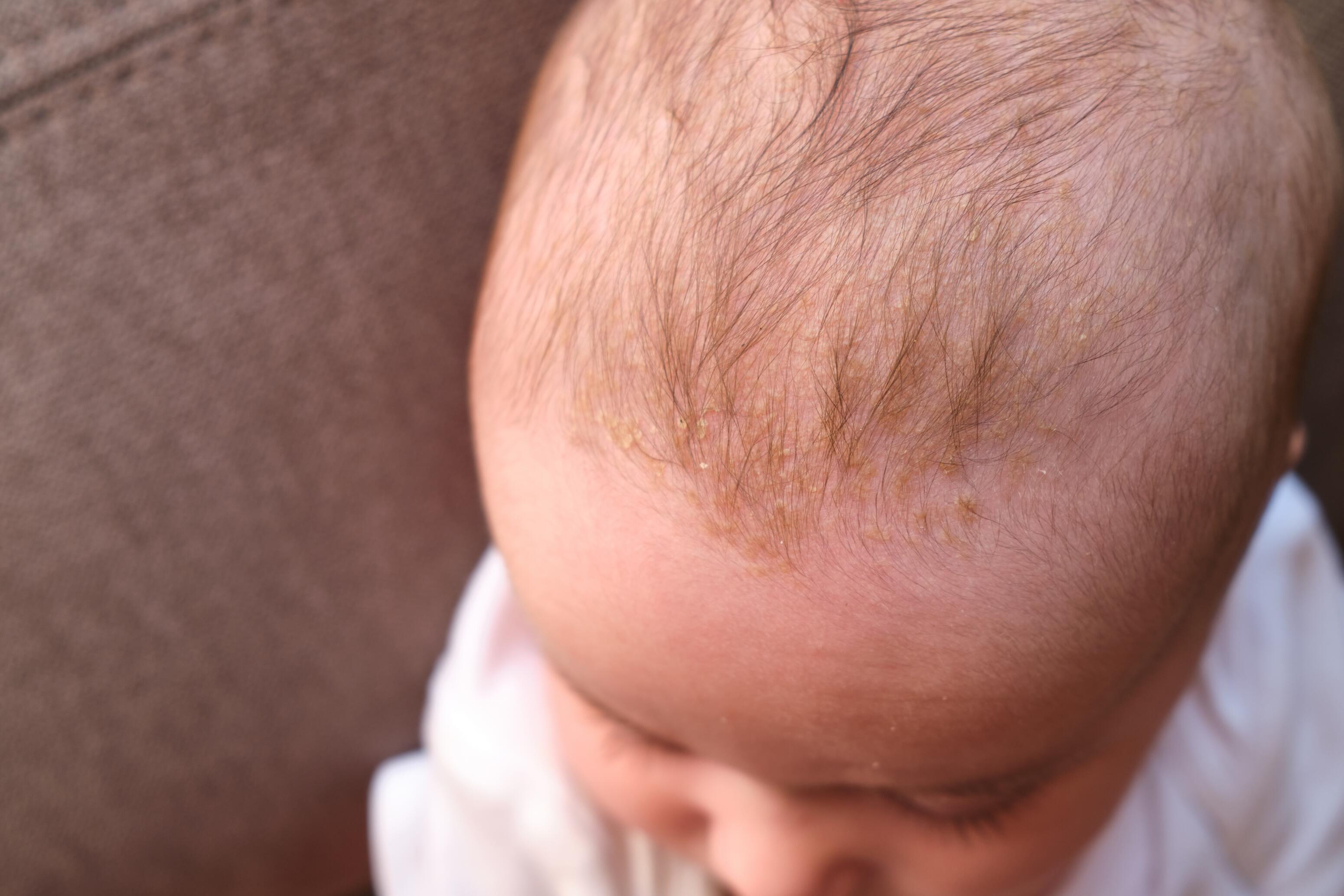
On the scalp, seborrheic dermatitis in babies manifests itself as the appearance of thick, oily, sticky, white or yellow scales. These scales can extend as far as the eyebrows and sometimes cause slight redness around the scabs.
For parents, these symptoms may seem daunting, but they are harmless and often only require gentle scalp maintenance.
In the case of diaper rash, symptoms may be limited to the folds of the skin, such as those on the thighs or buttocks, where the skin is often more moist.
In some cases, dermatitis can appear as a bright red area, as if the baby were wearing red 'knickers'. This is a colourful way of describing the intense redness that can cover this area.
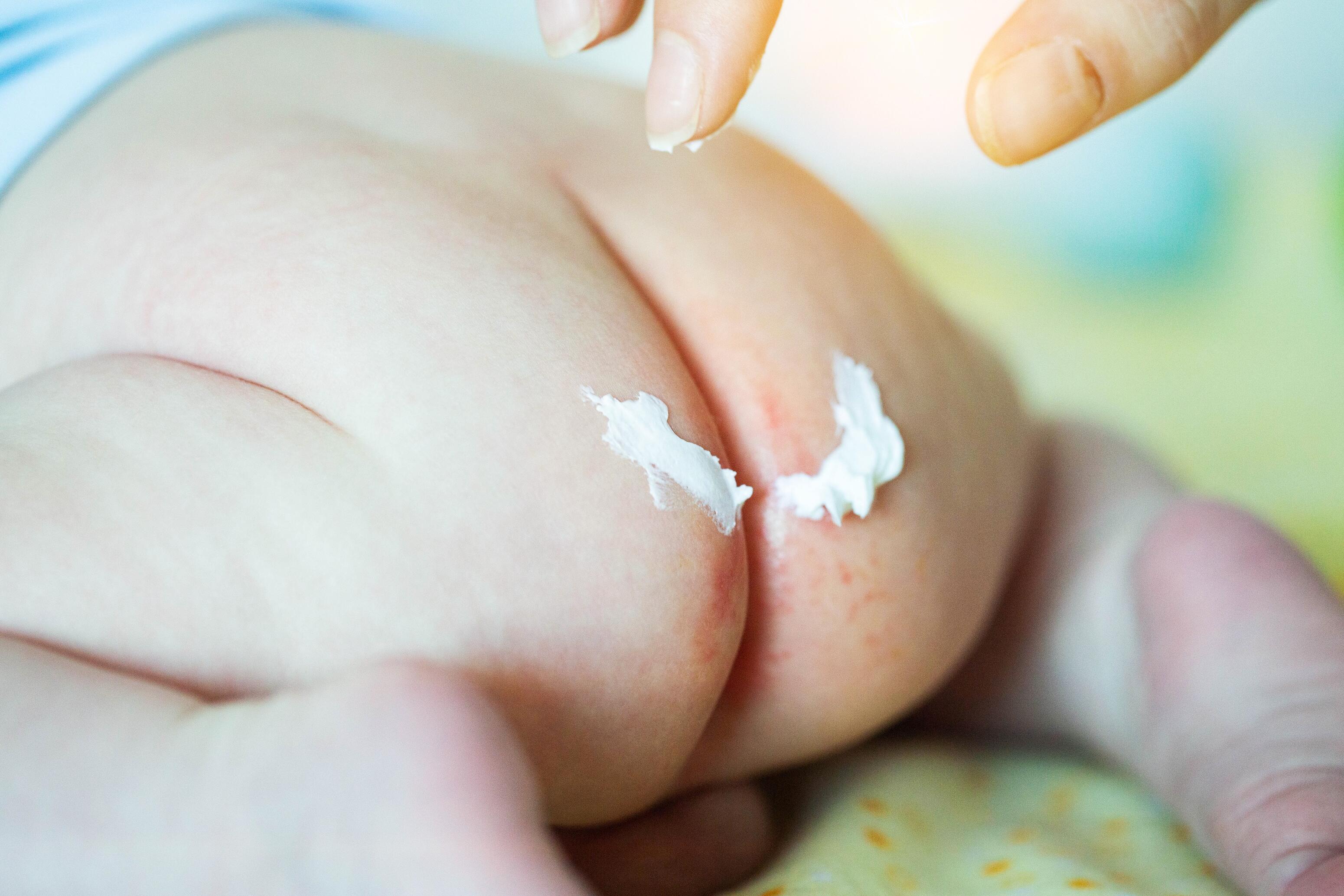
In addition to the diaper area, similar redness can also be seen in other folds of the body, such as the armpits (axillary folds), neck (cervical folds), and sometimes even the folds of the elbows and knees. These areas are particularly sensitive because they are often more moist, which can encourage the appearance of redness.
Infant seborrheic dermatitis (cradle cap): what to do?
Infant seborrheic dermatitis, better known as cradle cap, is caused by excessive sebum production (hyperseborrhoea) and the proliferation of a yeast of the genus Malassezia. This yeast is the same as the one involved in seborrheic dermatitis in adults.
Infant seborrheic dermatitis is not a serious condition; it causes no discomfort or itching and disappears spontaneously after a few weeks. Nevertheless, the unsightly and unattractive appearance of this condition can be distressing and unpleasant for parents.
To help get rid of persistent cradle cap, you can use gentle shampoos or treatment products specially designed for babies, available from chemists or drugstores. Their role is to soften the scabs so that they can be lifted from the hair more easily, thanks to both the gentle massage during application and the active ingredients in the formula.
Advice for parents and treatment
First of all, it is essential to consult a paediatrician to confirm the diagnosis of seborrheic dermatitis in infants, as cradle cap can sometimes be confused with atopic eczema.
The paediatrician will also be able to make sure that the cradle caps resolve properly over time.
Here are a few recommendations for taking good care of your baby's scalp:
- Above all, avoid pulling or scratching the cradle cap, either with your fingernails or dry, to avoid injuring your baby's scalp.
- Daily, for at least two weeks:
- Apply a cream or emulsion specifically developed for babies' sebo-squamous skin, formulated with gentle moisturising and keratolytic active ingredients. Gently massage the scalp to saturate the cradle cap and leave on for 10 to 15 minutes. This treatment helps to soften the scabs so that they peel off more easily.
- Then wash hair with a mild, frequent-use shampoo and rinse thoroughly with warm water.
- Then use a soft bristle brush to gently remove the softened scabs.
In the event of cradle cap or skin fold dermatitis, cleanse the skin with a lipid-enriched cleanser, formulated for infants, to soothe irritation. If flakes are visible, apply a gentle moisturising and keratolytic treatment to remove them more quickly.
Source :
(1) Mastrolonardo M, Diaferio A, Vendemiale G, Lopalco P. Seborrhoeic dermatitis in the elderly: inferences on the possible role of disability and loss of self-sufficiency. Acta Derm Venereol. (2004), Vol. 84, pp. 285-287.
Read also
- Discover Seborrheic dermatitis: scalp and hair loss
What is seborrheic dermatitis?
Seborrheic dermatitis: scalp and hair loss
- Discover Seborrheic dermatitis on the face: causes and treatment
What is seborrheic dermatitis?
Seborrheic dermatitis on the face: causes and treatment
- Discover Eczema or seborrheic dermatitis?
What is seborrheic dermatitis?
Eczema or seborrheic dermatitis?
- Discover Seborrheic dermatitis on the torso
What is seborrheic dermatitis?
Seborrheic dermatitis on the torso
- Discover Psoriasis or seborrheic dermatitis?
What is seborrheic dermatitis?
Psoriasis or seborrheic dermatitis?
Our targeted solutions for seborrheic dermatitis
Discover our complete range
- Anti-dandruff treatment shampoo
KELUAL DS ORIGINAL
Anti-dandruff treatment shampooEliminates severe dandruff - Eliminates dandruff after the first application* - Soothes itchiness* - Limits recurrences - Anti-scales cleansing gel
KELUAL DS
Anti-scales cleansing gelPurifies - Removes flakes - Soothes - Reduces redness


Our skincare routines
Irritated skin with redness and flakiness