
What are the different types of acne?
- SUMMARY
- Acne
Severe acne
- What can you do about acne on a daily basis?
- Acne and the sun
- What soap should you use for acne?
- Acne and sport
- What kind of make-up should you use for acne?
- Diet and acne
- Peels for acne
- Zinc to fight acne
- Masks to tackle acne
- Taking the pill to tackle acne
- The role of essential oils in treating acne
- Homeopathic remedies for acne
- Acne symptoms
- Acne on the back
- Acne spots: what are they?
- Acne or rosacea?
- Blackheads: what are they?
- Facial acne: how to get rid of it
- Spots on the buttocks (acne): how to get rid of them
- Acne on the forehead
- Acne spots on the lips: causes and solutions
- Whitehead
- Acne scars
- Acne on black skin: how to get rid of it
- Acne on the chin

Severe acne
Updated on , approved by our DUCRAY medical experts.
Cysts, nodules, pain... Severe acne, whether nodular acne, severe cystic acne or even acne fulminans, is often experienced as a real struggle.
So, you're wondering why some people develop these types of acne? What are the differences between "classic" acne and these severe forms of acne that sometimes leave permanent scars? And what are the solutions for relieving severe acne?
In this article, discover everything you need to know about severe acne and practical advice on how to deal with it.
How is severe acne defined?
Severe acne is a type of acne that manifests itself as significant lesions, often spread across the entire face.
The types of lesions visible in severe acne are(1):
- retentional acne lesions, with blackheads (open comedones) and whiteheads (closed comedones).
- inflammatory lesions (papules, pustules, cysts and nodules) that cause pain and redness.
Other areas of the body, such as the back, are frequently affected, accentuating the physical and psychological impact of this form of acne.
Who is affected by severe acne?
Among people with acne, approximately 12% develop a severe form of acne(1), mainly adolescents with juvenile acne, but also adults.
Severe acne seems to affect boys more than girls. A family history of acne is often found, suggesting a significant genetic factor.
What causes severe acne?
Severe acne is influenced by several interacting factors:
- Male hormones, called androgens, stimulate sebum production, especially during adolescence. This excess sebum can clog pores and create an ideal environment for inflammation.
- Stress also plays a role: cortisol, released in the body during times of stress, also affects sebum production, which can make things worse.
- Genetic predisposition: if your parents had severe acne, you are likely to be affected too.
- The microbiome: the skin naturally harbours a bacterium called Cutibacterium acnes. When pores are blocked, this bacterium proliferates and triggers inflammation. But be careful, it is not only the presence of this bacterium that causes acne: it is also linked to an imbalance of bacteria present in the skin microbiome.
- Environment and lifestyle can also have a negative impact on skin quality.
What are the consequences of severe acne?
Severe acne has many repercussions, both physical and psychological.
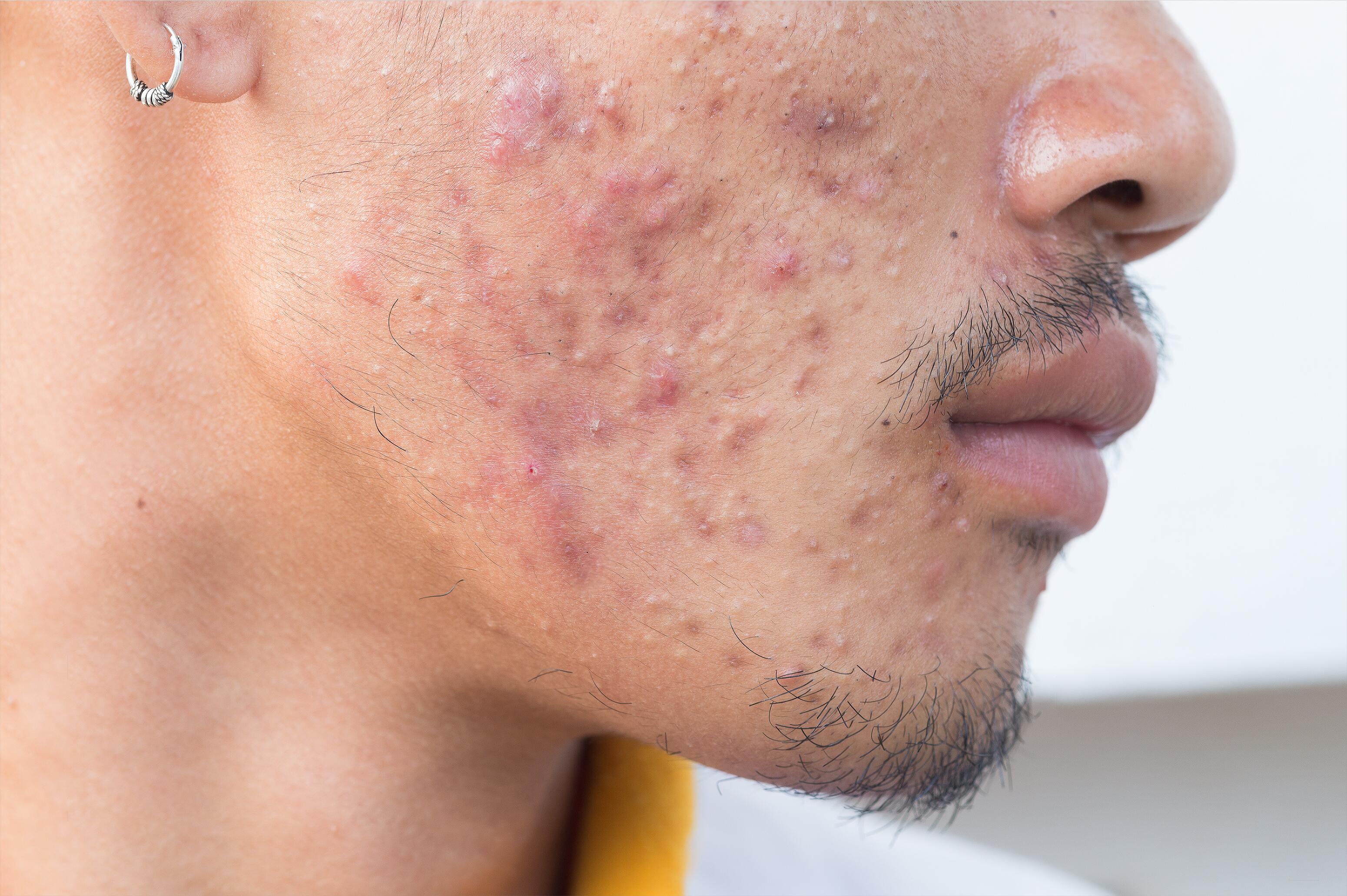
Scars that are sometimes irreversible
Deep lesions such as nodules or cysts, typical of severe acne, can leave visible marks for life: indented or thickened scars, or pigment spots.
This is why it is strongly advised not to "pick at" your spots. The priority is to start medical treatment with a professional and appropriate follow-up.
As for extracting severe acne spots, this should always be done by a dermatologist or qualified professional in order to minimise scarring.
A major psychological impact
Severe acne can profoundly affect mental wellbeing:
- The fear of other people's looks and comments.
- Lower self-esteem and a lack of self-confidence.
- Withdrawal into oneself, which can lead to isolation.
- A risk of depression.
- An impact on academic or professional success.
Comprehensive treatment of severe acne is essential: caring for the skin, but also providing quality support and listening.
Restrictive treatments for severe acne
Severe forms of acne often require prolonged treatment, sometimes with side effects.
Any treatment for severe acne requires rigorous medical supervision and perseverance.
An impact on quality of life
To measure the extent to which acne can affect quality of life, doctors have tools at their disposal(2), such as:
- CADI (Cardiff Acne Disability Index): this is a quick 5-question questionnaire that assesses the emotional and social impact of the acne.
- DLQI (Dermatology Life Quality Index): here, 10 aspects of life are assessed, such as leisure activities, work and social relationships.
What treatments are available for severe acne?
As a first step, the dermatologist may prescribe an oral antibiotic, often combined with topical treatments (applied locally).
For the most severe or resistant forms, the dermatologist will prescribe oral isotretinoin(3). This treatment for severe acne has a comprehensive effect on acne but tends to irritate and dry out the skin. Compensatory care is therefore recommended to limit these effects.
Currently, new advances in acne treatment(4) make it possible to combine several active ingredients in a single formula. The benefit? It’s twofold! Acting on multiple levels while simplifying application and improving tolerance.
Prevention strategies: how can we promote the prevention of severe acne?
To prevent severe acne, adopt a good skincare routine, use products that are suitable for your skin type and have been dermatologically tested, watch your diet and consult a professional promptly if necessary.
There is a lot of information circulating about severe acne, but what is the reality? Let’s look at the most common misconceptions.
Our responses to common misconceptions about severe acne
Here are four important things to avoid doing if you have severe acne:
- Washing your face too much, as this can cause excess sebum production.
- Do not squeeze or pop spots yourself, as this may increase scarring and the risk of infection.
- "Stripping" your skin by using abrasive treatments such as scrubs, as this may weaken the skin barrier and aggravate inflammation.
- Stopping medical treatment too early, as this may lead to a relapse.
Yes, unfortunately... Deep spots such as nodules or cysts can leave permanent marks if your acne is not treated in time. These scars may be indented or thickened, but treatments such as laser therapy or chemical peels can reduce their appearance.
Diet does not directly cause acne, but certain foods consumed in excess, in the context of a diet that lacks variety, can indeed influence severe acne.
The key to good health in general, and we cannot stress this enough, is to start by adopting a varied and balanced diet every day.
No! The sun may appear to improve acne, but in reality, it thickens the skin, which can clog pores and worsen acne in the long term. Not to mention the risk of post-acne spots and scars.
Instead, try to avoid sun exposure and, if this is not possible, use an SPF50+ sun cream that is suitable for acne-prone skin.
Sources :
(1) Stein Gold L, Baldwin HE, Lin T. Management of Severe Acne Vulgaris With Topical Therapy. J Drugs Dermatol. 2017 Nov 1;16(11):1134-1138. PMID: 29141062.
(2) Alsulaimani H, Kokandi A, Khawandanh S, Hamad R. Severity of Acne Vulgaris: Comparison of Two Assessment Methods. Clin Cosmet Investig Dermatol. 2020 Sep 28;13:711-716. doi: 10.2147/CCID.S266320. PMID: 33061511; PMCID: PMC7532287.
(3) Leung, A., Barankin, B., Lam, J., Leong, K., & Hon, K. (2021). Dermatology: how to manage acne vulgaris. Drugs in Context, 10.
(4) Mohsin N, Hernandez LE, Martin MR, Does AV, Nouri K. Acne treatment review and future perspectives. Dermatol Ther. 2022 Sep;35(9):e15719. doi: 10.1111/dth.15719. Epub 2022 Jul 26. PMID: 35841269
Read also
- Discover Acne in women
What are the different types of acne?
Acne in women
- Discover Cystic acne
What are the different types of acne?
Cystic acne
- Discover Acne fulminans
What are the different types of acne?
Acne fulminans
- Discover Neonatal acne
What are the different types of acne?
Neonatal acne
- Discover Retentional acne
What are the different types of acne?
Retentional acne
- Discover Inflammatory acne
What are the different types of acne?
Inflammatory acne
- Discover Acne in men
What are the different types of acne?
Acne in men
- Discover Juvenile acne
What are the different types of acne?
Juvenile acne
Our targeted solutions for acne
Discover our complete range
- Anti-blemishes cleansing gel face and body
KERACNYL
Anti-blemishes cleansing gel face and bodyCleanses - Helps to get rid of imperfections - Anti-Blemish Cream
KERACNYL PP+
Anti-Blemish CreamAvoids skin marks - Helps to get rid of imperfections - Compensates for the effects of drying treatments


Our skincare routines
Oily or acne-prone skin
- Discover Anti-blemish face care summer routine for adult skin
Anti-blemish face care summer routine for adult skin
Do you have blemish-prone skin as an adult?