
What can you do about acne on a daily basis?
- SUMMARY
- Acne
Homeopathic remedies for acne
- What can you do about acne on a daily basis?
- Acne and the sun
- What soap should you use for acne?
- Acne and sport
- What kind of make-up should you use for acne?
- Diet and acne
- Peels for acne
- Zinc to fight acne
- Masks to tackle acne
- Taking the pill to tackle acne
- The role of essential oils in treating acne
- Homeopathic remedies for acne
- Acne symptoms
- Acne on the back
- Acne spots: what are they?
- Acne or rosacea?
- Blackheads: what are they?
- Facial acne: how to get rid of it
- Spots on the buttocks (acne): how to get rid of them
- Acne on the forehead
- Acne spots on the lips: causes and solutions
- Whitehead
- Acne scars
- Acne on black skin: how to get rid of it
- Acne on the chin

Homeopathic remedies for acne
Updated on , approved by our DUCRAY medical experts.
Creams, medication, natural remedies... When you suffer from acne, you are often willing to try anything. Among the solutions that come up regularly: homeopathy for acne. Presented as a gentle approach with no side effects, it nevertheless divides the scientific community.
So, can homeopathy really help acne? What results can be expected on acne or scars? Find out more in this article.
Understanding acne
Acne is an inflammatory disease that affects the hair follicles and sebaceous glands. The cause: excess sebum, an imbalance in the skin microbiome and an excessive immune response(1).
Several factors influence the onset of acne(2): hormones, genetics, environment, lifestyle, diet, etc.
Conventional treatments (retinoids, azelaic acid, antibiotics, isotretinoin, etc.) target these mechanisms. However, some may seek a gentler complementary approach. Homeopathy for acne can be considered in this case to "rebalance" the body and reduce inflammation from within, although its effectiveness remains debated(3).
What is homeopathy?
Homeopathy is based on the use of natural substances from three main categories: plants, minerals and animal-derived substances.
The principle of homeopathy is this: a substance capable of causing a symptom in a healthy person could, once diluted, help treat that same symptom in a sick person. This is known as the principle of similarity, formulated in the 18th century by the German physician Samuel Hahnemann(4).
So, what is the process for manufacturing homeopathic remedies? Unlike conventional medicines, homeopathic remedies are obtained through a series of successive dilutions (in water or alcohol) interspersed with shaking (known as potentisation). For example, a 5CH dilution still contains traces of the original substance, while a 30CH dilution is extremely diluted, with little or no detectable initial molecules.
Homeopathic treatments come in various forms: granules, drops, ampoules, ointments, or tablets. Some pharmacies have a specific section dedicated to homeopathic medicines, while others must order them on request.
If you would like advice on homeopathy for acne, consult with a healthcare professional trained in homeopathy.
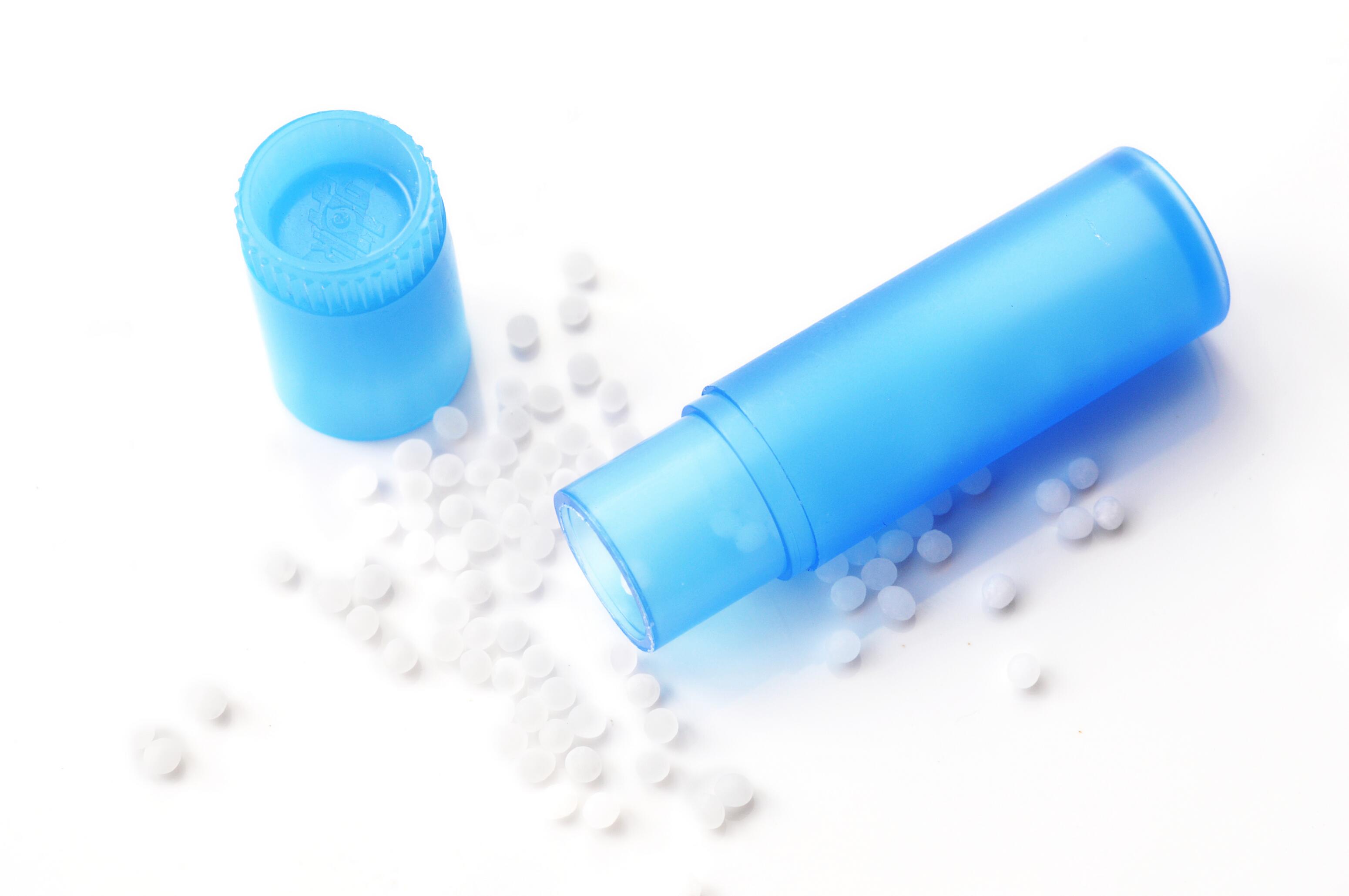

Homeopathic treatments for acne
Homeopathy is based on an individualised approach(5): the remedy is chosen based on the patient's skin type, specific symptoms and even emotional profile.
Several strains may be recommended in homeopathy for acne. Examples include:
- Lycopodium, Palladium, Platinum.
- Sulphur and Tuberculinum.
- Natrium Chloridum, Calcium Phosphoricum, Pulsatilla Nigricans.
For rosacea, homeopathy also offers individualised approaches, as it does for microcystic or moderate to mild acne.
Please note: some studies suggest an improvement in acne symptoms with homeopathic treatment, but scientific evidence remains limited and controversial to date. Some research shows benefits in terms of quality of life and reduced acne severity, while other studies conclude that its effectiveness is similar to that of a placebo(6).
Practical tips for using homeopathic remedies
Homeopathy may be an option for those seeking a more natural approach without side effects. However, in the absence of a clear scientific consensus, it is not the first treatment prescribed or recommended for acne (particularly severe acne).
Therefore, in all cases, it is advisable to consult with a healthcare professional before considering this type of treatment. Here are some practical tips for using homeopathy to treat acne:
- First, consult with a doctor who specialises in homeopathy, then purchase homeopathic remedies manufactured by recognised laboratories that specialise in homeopathy (preferably from pharmacies or certified online sites).
- During your homeopathic treatment for acne, it is important to continue seeing your usual doctor regularly and never to stop any medical treatment without their advice.
- In general, follow the dosage recommendations given by your homeopathic doctor (take between meals, under the tongue, as a long-term treatment, etc.) and adopt a healthy lifestyle and daily skincare routine suited to your skin type.
Consultation with a homeopath for acne
An initial consultation generally lasts between 30 minutes and an hour. Unlike traditional appointments with a dermatologist, homeopaths take a holistic (comprehensive) approach, seeking to treat the patient as a whole rather than focusing solely on acne.
The homeopath asks detailed questions about(7):
- The current context and imbalances that can affect the skin, such as digestion, stress, diet, menstrual cycle, sleep, etc.
- Associated symptoms (digestive problems, sleep issues, emotional state, etc.).
- Family and medical history.
These elements enable a homeopathic profile to be established and the most appropriate homeopathic remedy for acne to be selected for each patient's specific needs.
Beyond remedies, consultation as such therefore plays an important role in listening and providing psychological support. Some patients report feeling better understood and supported than during a traditional consultation. This practitioner-patient relationship is often cited as one of the advantages of homeopathy(8). However, it does not replace follow-ups with a dermatologist, particularly in cases of severe or persistent acne.
Can homeopathy reduce acne scars?
Homeopathic remedies for acne may be considered to support overall healing, but they are not a substitute for dermatological treatments. They can therefore be incorporated as a supplement, particularly for people seeking a more natural approach.
Regardless of the approach, certain habits can promote skin repair, including the following:
- Remember to cleanse your skin thoroughly morning and night with a skincare product suitable for acne-prone skin.
- Remember to moisturise your skin well to help it heal better.
- Apply SPF 50+ sun cream to prevent hyperpigmentation of scars.
- Eat a diet rich in antioxidants and collagen: vitamin C, zinc, omega-3, protein, bone broth, etc. to support cell regeneration.
- Consider massaging the scars to stimulate microcirculation and improve skin elasticity.
If you have noticeable scars, consult with your dermatologist for advice on choosing a suitable treatment strategy.
Sources :
(1) Jin, Z., Song, Y., & He, L. (2023). A review of skin immune processes in acne. Frontiers in Immunology, 14.
(2) Yang, J., Yang, H., Xu, A., & He, L. (2020). A Review of Advancement on Influencing Factors of Acne: An Emphasis on Environment Characteristics. Frontiers in Public Health, 8.
(3) Maftei NM, Nechifor A, Tan B, Elisei AM, Pelin AM, Nechita L, Tatu AL, Leow LJ, Nwabudike LC. Therapeutic Applications for Homeopathy in Clinical Practice. Adv Ther. 2024 Nov 8. doi: 10.1007/s12325-024-03022-5. Epub ahead of print. PMID: 39514042.
(4) Barbier, P. (1988). Samuel Hahnemann (1755–1843). Nature, 151, 724-724.
(5) Nwabudike, L. (2021). Individualised Homeopathic Treatment of Acne—An Analysis of 83 Patients. Homeopathy, 110, 271 - 276.
(6) Rai S, Gupta GN, Singh S, Michael J, Misra P, Gupta B, Singh S, Prakash A, Tomar M, Sadhukhan S, Koley M, Saha S. Efficacy of Individualized Homeopathic Medicines in Treatment of Acne Vulgaris: A Double-Blind, Randomized, Placebo-Controlled Trial. Homeopathy. 2022 Nov;111(4):240-251. doi: 10.1055/s-0041-1739397. Epub 2022 Mar 17. PMID: 35299272.
(7) Bagot, J. (2018). The specific characteristics of a homeopathic consultation. La Revue d'Homéopathie.
(8) Eyles, C., Leydon, G., Lewith, G., & Brien, S. (2010). A Grounded Theory Study of Homeopathic Practitioners' Perceptions and Experiences of the Homeopathic Consultation. Evidence-based Complementary and Alternative Medicine : eCAM, 2011.
Read also
- Discover Taking the pill to tackle acne
What can you do about acne on a daily basis?
Taking the pill to tackle acne
- Discover Masks to tackle acne
What can you do about acne on a daily basis?
Masks to tackle acne
- Discover Peels for acne
What can you do about acne on a daily basis?
Peels for acne
- Discover Zinc to fight acne
What can you do about acne on a daily basis?
Zinc to fight acne
- Discover Acne and sport
What can you do about acne on a daily basis?
Acne and sport
- Discover What kind of make-up should you use for acne?
What can you do about acne on a daily basis?
What kind of make-up should you use for acne?
- Discover What soap should you use for acne?
What can you do about acne on a daily basis?
What soap should you use for acne?
- Discover Acne and the sun
What can you do about acne on a daily basis?
Acne and the sun
- Discover Diet and acne
What can you do about acne on a daily basis?
Diet and acne
Our targeted solutions for acne
Discover our complete range
- Anti-blemishes cleansing gel face and body
KERACNYL
Anti-blemishes cleansing gel face and bodyCleanses - Helps to get rid of imperfections - Anti-Blemish Cream
KERACNYL PP+
Anti-Blemish CreamAvoids skin marks - Helps to get rid of imperfections - Compensates for the effects of drying treatments


Our skincare routines
Oily or acne-prone skin
- Discover Anti-blemish face care summer routine for adult skin
Anti-blemish face care summer routine for adult skin
Do you have blemish-prone skin as an adult?