
What causes acne?
- SUMMARY
- Acne
Fungal acne
- Acne symptoms
- Acne on the back
- Acne or rosacea?
- Acne spots: what are they?
- Blackheads: what are they?
- Facial acne: how to get rid of it
- Spots on the buttocks (acne): how to get rid of them
- Acne spots on the lips: causes and solutions
- Whitehead
- Acne on the forehead
- Acne scars
- Acne on black skin: how to get rid of it
- Acne on the chin
- What can you do about acne on a daily basis?
- What soap should you use for acne?
- What kind of make-up should you use for acne?
- Acne and the sun
- Peels for acne
- Diet and acne
- Zinc to fight acne
- Acne and sport
- Taking the pill to tackle acne
- Masks to tackle acne
- The role of essential oils in treating acne
- Homeopathic remedies for acne

Persistent spots, redness, intense itching... And yet, despite your acne treatments, nothing works?
Are you wondering whether your spots are related to acne or whether they might be something else? You’re right to ask the question: you may be suffering from fungal acne.
Fungal acne is often difficult to identify because it closely resembles classic acne. But unlike classic acne, which is caused by bacteria and excess sebum, fungal acne is caused by the proliferation of a yeast called Malassezia, which is naturally present on the skin.
So how can you tell if you really have fungal acne? What are the characteristic signs of fungal acne? What are the appropriate treatments in such a case?
In this article, we help you see things more clearly.
Symptoms of fungal acne
The symptoms of fungal acne often resemble those of common acne, but there are still some distinctive signs that can tip you off. In particular, you may observe:
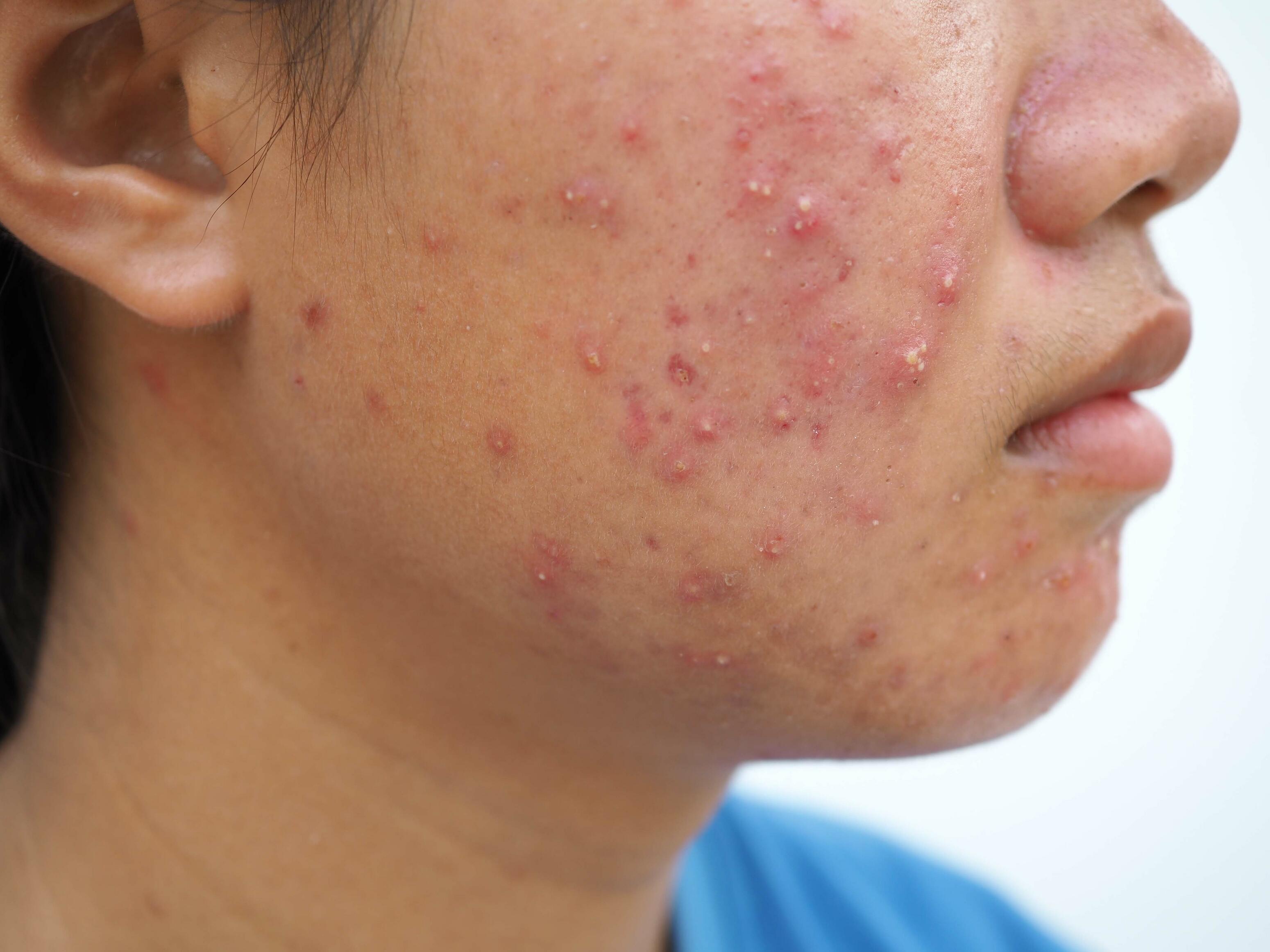
- red spots of uniform size and often grouped together: unlike classic acne, where spots are often of varying sizes, fungal acne manifests as papules (small red bumps) and pustules (bumps containing pus) that are uniform in size (1 to 2 mm) and grouped together, which can give the skin a grainy appearance.
- intense itching: this is the most tell-tale sign. Fungal acne is often pruritic. In other words, it itches a lot! So if your spots irritate to the point where you want to scratch them, this should grab your attention.
- Specific affected areas: fungal acne frequently appears on areas such as the upper back, chest, shoulders and sometimes on the chin and sides of the face. And unlike common acne, it less often affects the centre of the face (forehead, nose).
- Resistance to acne treatments: if your spots persist despite acne treatments (such as antibiotics), or get worse, it may be fungal acne. Antibiotics, by disrupting the skin microbiota, can promote the proliferation of Malassezia yeast, which is responsible for this condition.
When should you react? If your spots persist, are itchy and often appear after periods of increased perspiration (such as after exercise or in hot, humid environments), fungal acne is something to consider. And in that case, it's definitely time to make an appointment with your dermatologist.
Risk factors and predispositions
Unlike classic acne, which is often linked to hormonal fluctuations, fungal acne is caused by excessive proliferation of the Malassezia yeast, which is naturally present on the skin.
Several risk factors may contribute to its onset or aggravate symptoms. These notably include:
- Oily skin: Malassezia yeast loves sebum.
- Excessive perspiration: a warm, humid environment, such as tropical climates or heavy sweating after exercise, creates a breeding ground for the proliferation of Malassezia yeast on the skin.
- Moisture associated with friction: tight clothing, excessive perspiration, or restricted areas are also favourable conditions.
- Prolonged antibiotic treatments: when fungal acne is already present or developing, antibiotics prescribed to treat bacterial acne disrupt the skin's microbiota by eliminating good bacteria. This imbalance then promotes the proliferation of Malassezia yeast, which is responsible for fungal acne. Result: this form of acne can appear, worsen or coexist with common acne! This therefore requires appropriate care.
- Corticosteroids (applied locally or taken orally): these treatments can weaken the skin's natural defences, thereby promoting fungal acne. More generally, any situation in which the immune system is weakened (due to illness, chronic fatigue, medical treatments, etc.) increases the risk of fungal acne.
- An unsuitable skincare routine, such as using products that are too rich in oils or comedogenic ingredients, can upset the balance of the skin's microbiota and promote the growth of Malassezia yeast.
Treating fungal acne
Fungal acne may seem difficult to manage, but rest assured, with the right treatment, it can be remedied.
Fungal acne is usually treated with a prescription of oral antifungal medications such as ketoconazole or fluconazole. Antifungal medicines, administered orally, act directly on the Malassezia yeast by blocking its growth. They are particularly recommended when symptoms persist or cover large areas such as the back, chest or shoulders(1).
In addition, topical antifungal creams or lotions can be applied locally to treat lesions and prevent recurrence. These topical treatments are useful for milder cases or in combination with an oral treatment to enhance its effectiveness(1).
If fungal acne is present alongside inflammatory acne, a combined approach is necessary(1):
- Oral or topical antifungals will target the Malassezia yeast, which is responsible for fungal acne.
- Conventional acne treatments act on the bacteria associated with classic acne.
Combining these two approaches makes it possible to treat both the fungal and bacterial causes, thereby maximising effectiveness.
So consult with your dermatologist as soon as possible: they will be able to guide you in adapting the treatment to your specific needs.
Tips for preventing fungal acne
Fungal acne often appears when the skin remains damp or sweats heavily.
To prevent this, it is essential to keep the skin clean and dry:
- After sport or any physical activity, change quickly and dry yourself thoroughly, paying particular attention to areas prone to rubbing (back, shoulders, chest).
- Wear loose-fitting, breathable clothing made of cotton or natural materials to minimise friction and heat build-up. Avoid wearing clothes that are too tight or made of synthetic materials, as these promote perspiration.
- Cleanse your skin morning and evening with a foaming cleansing gel,specifically designed for oily or acne-prone skin. Avoid harsh soaps that may disrupt the skin's natural barrier. Also take the time to gently dry your skin after washing, without rubbing.
- Opt for a non-comedogenic moisturiser that is also suitable for oily or acne-prone skin.
- Remember to change your towels and pillowcases regularly (ideally every 2 to 3 days). Opt for soft fabrics made from natural materials (cotton, silk, etc.).
- Avoid hot and humid environments such as spas, steam rooms, or hot tubs, which create a breeding ground for yeasts such as Malassezia.
Sources :
(1) Rubenstein, R., & Malerich, S. (2014). Malassezia (pityrosporum) folliculitis.. The Journal of clinical and aesthetic dermatology, 7 3, 37-41.
Read also
- Discover Hormonal acne
What causes acne?
Hormonal acne
- Discover Bacteria: Cutibacterium acnes
What causes acne?
Bacteria: Cutibacterium acnes
- Discover Acne and stress
What causes acne?
Acne and stress
- Discover Excess sebum
What causes acne?
Excess sebum
Our targeted solutions for acne
Discover our complete range
- Anti-blemishes cleansing gel face and body
KERACNYL
Anti-blemishes cleansing gel face and bodyCleanses - Helps to get rid of imperfections - Anti-Blemish Cream
KERACNYL PP+
Anti-Blemish CreamAvoids skin marks - Helps to get rid of imperfections - Compensates for the effects of drying treatments


Our skincare routines
Oily or acne-prone skin
- Discover Anti-blemish face care summer routine for adult skin
Anti-blemish face care summer routine for adult skin
Do you have blemish-prone skin as an adult?