
Acne symptoms
- SUMMARY
- Acne
Spot on the lip: acne or cold sore?
- Acne symptoms
- Acne on the back
- Acne or rosacea?
- Acne spots: what are they?
- Blackheads: what are they?
- Facial acne: how to get rid of it
- Spots on the buttocks (acne): how to get rid of them
- Acne spots on the lips: causes and solutions
- Whitehead
- Acne on the forehead
- Acne scars
- Acne on black skin: how to get rid of it
- Acne on the chin
- What can you do about acne on a daily basis?
- What soap should you use for acne?
- What kind of make-up should you use for acne?
- Acne and the sun
- Peels for acne
- Diet and acne
- Zinc to fight acne
- Acne and sport
- Taking the pill to tackle acne
- Masks to tackle acne
- The role of essential oils in treating acne
- Homeopathic remedies for acne

Spot on the lip: acne or cold sore?
Updated on , approved by our DUCRAY medical experts.
A spot on the lip can be confusing. How can you tell whether it is a spot, a cold sore or another skin irritation? Why has this spot appeared in the centre (or on the edge) of the lip? Should you be concerned if it is red, painful or filled with fluid? How long will it last?
First and foremost, it is important to correctly identify the cause of this spot. It is best to seek advice from a healthcare professional, but in the meantime, here is some information to help you tell the difference between a spot and a cold sore.
In this article, discover all the essential information about acne spots on the lips.
The differences between a stop on the lip and a cold sore
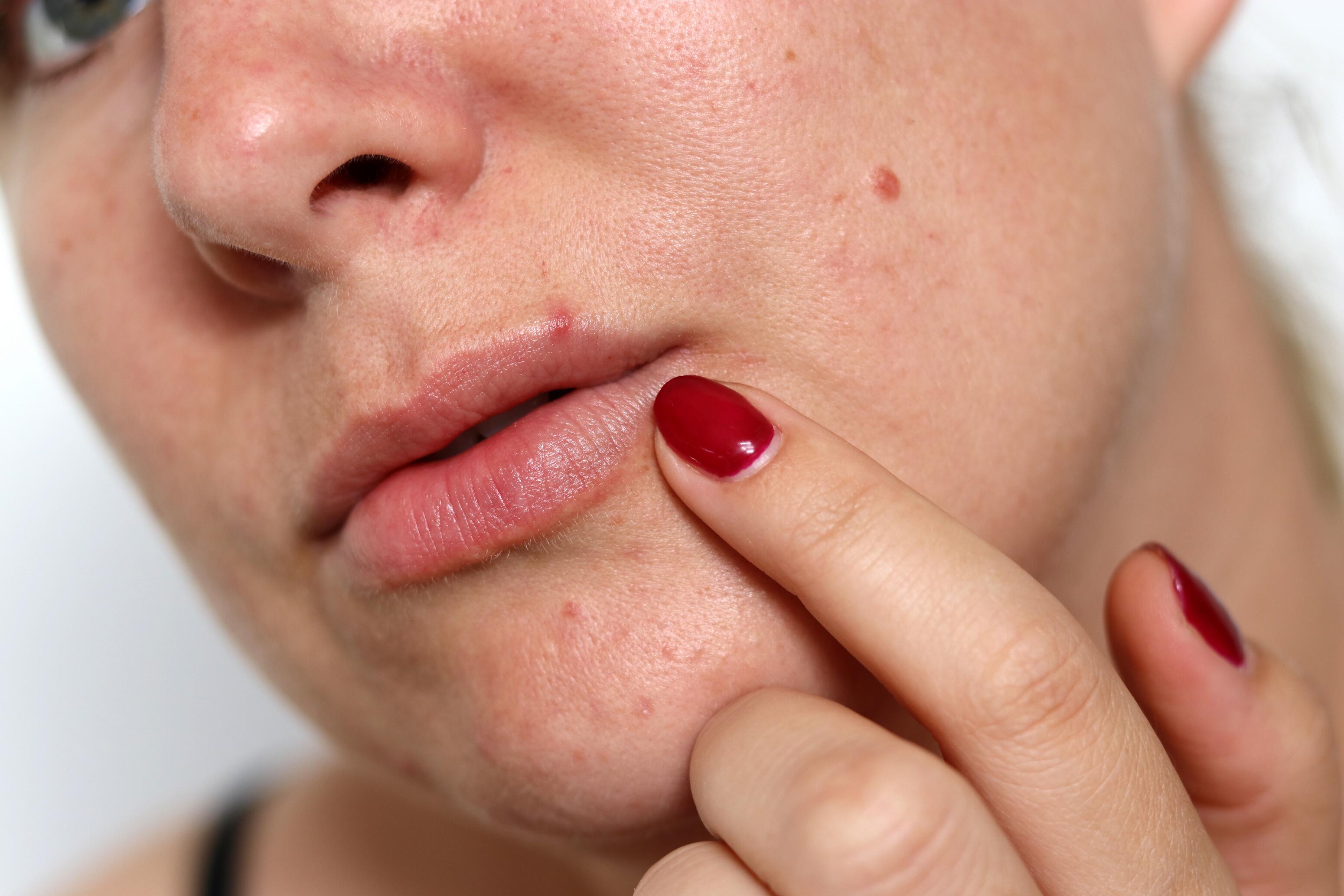
In terms of appearance:
- A spot on the lip can be a whitehead or a red spot, often located around the mouth(1).
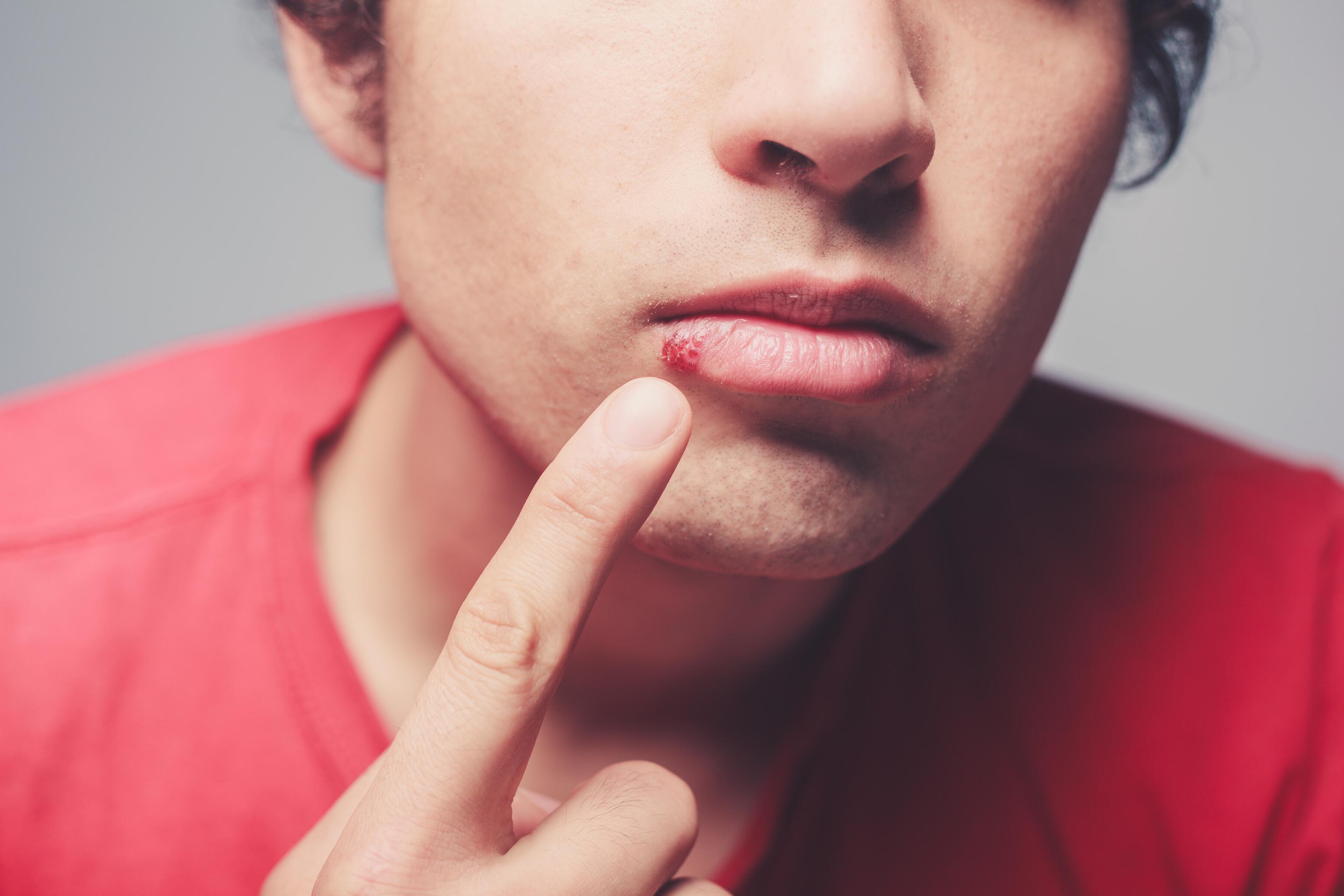
- A cold sore (or herpes labialis), on the other hand, looks like small blisters filled with fluid, often clustered around the edge of the lips(2).
In terms of sensations:
- A spot on the lip can be painful, but without warning signs.
- A cold sore, on the other hand, begins with tingling, burning or itching.
In terms of the development of acne or cold sores:
- A spot on the lip remains localised and may develop into a pustule (red spot with white pus). It may last a few days, but the spot usually disappears without leaving a mark if you do not touch it(1).
- A cold sore, on the other hand, follows a specific cycle(2): appearance of blisters filled with clear fluid, bursting of the blisters, formation of a scab, then healing. This develops over several days, with frequent recurrences during periods of stress, exposure to sunlight or severe fatigue (with a decrease in the body's defences). Be careful, cold sores are highly contagious!
Recognising a spot on your lip
A spot on the lip may look like a whitehead (closed comedone) or a red spot that may be painful.
These acne spots on the lip may appear around the mouth, on the lip contour. However, unlike cold sores, they do not itch before they appear and do not form blisters.
If you have acne spots on your lips, it is likely that you also have acne spots on other areas of your face (forehead, nose, chin, etc.)(1).
The causes of a spot on the lip
A spot on the lip can have several causes. It could be a spot, a cold sore (herpes labialis) or an irritant or allergic reaction:
- A spot on the lip forms due to the blockage of a pore located at the edge of the lips, mainly due to excess sebum and a build-up of dead skin cells. Several factors contribute to this condition, including a hormonal imbalance and genetic predisposition(1)...
- A cold sore(2) is caused by the herpes simplex virus (HSV-1). Once contracted, this virus remains dormant in the body and is reactivated by several triggers, such as stress, fatigue, prolonged exposure to the sun, or direct contact with a person carrying the virus(3). Indeed, cold sores are highly contagious!
Certain ingredients contained in cosmetic products can also cause skin reactions with the rapid appearance (after contact) of spots on the lip, accompanied by swelling and/or itching. This may be due to fragrances, preservatives, or colourings present in make-up products, lipsticks, toothpastes, or foodstuffs.
If you develop spots on your lip, always seek medical advice to obtain the correct diagnosis and appropriate treatment.
Treatments and advice for acne spots on the lip
While waiting to consult with your dermatologist, here are some initial tips on the skincare routine to adopt if you have acne spots on your lips(4):
- Thoroughly cleanse your face and the area around your lips, morning and evening, with a purifying foaming gel suitable for acne-prone skin (soap-free and non-comedogenic).
- Apply a moisturising anti-blemish serum that contains keratolytic and sebum-regulating active ingredients (glycolic acid, azelaic acid, etc.) to the entire face and the acne spot (lip).
- If you wear make-up, ensure that the products are non-comedogenic, suitable for sensitive skin, and formulated with a minimum of ingredients.
- Avoid touching or squeezing the spot.
- Protect your skin from the sun throughout the healing process.
In the event of a cold sore (herpes labialis), it is recommended to use a local antiviral treatment as soon as the first tingling sensation appears and to avoid direct contact to limit contagion. Ask your pharmacist for advice.
Sources :
(1) https://dermato-info.fr/fr/la-peau-des-adultes/l%E2%80%99acn%C3%A9
(2) https://www.vidal.fr/maladies/peau-cheveux-ongles/bouton-fievre-herpes-labial.html
(3) https://ameli.fr
(4) https://www.msdmanuals.com/fr/accueil/troubles-cutan%C3%A9s/acn%C3%A9-et-troubles-associ%C3%A9s/acn%C3%A9#Diagnostic_v8517451_fr
Read also
- Discover Acne on black skin: how to get rid of it
Acne symptoms
Acne on black skin: how to get rid of it
- Discover Acne scars
Acne symptoms
Acne scars
- Discover Acne on the forehead
Acne symptoms
Acne on the forehead
- Discover Spots on the buttocks (acne): how to get rid of them
Acne symptoms
Spots on the buttocks (acne): how to get rid of them
- Discover Facial acne: how to get rid of it
Acne symptoms
Facial acne: how to get rid of it
- Discover Whiteheads: how to treat and get rid of them
Acne symptoms
Whiteheads: how to treat and get rid of them
- Discover Acne spots: what are they?
Acne symptoms
Acne spots: what are they?
- Discover Acne or rosacea?
Acne symptoms
Acne or rosacea?
- Discover Blackheads: what are they?
Acne symptoms
Blackheads: what are they?
- Discover Acne on the back
Acne symptoms
Acne on the back
Our targeted solutions for acne
Discover our complete range
- Anti-blemishes cleansing gel face and body
KERACNYL
Anti-blemishes cleansing gel face and bodyCleanses - Helps to get rid of imperfections - Anti-Blemish Cream
KERACNYL PP+
Anti-Blemish CreamAvoids skin marks - Helps to get rid of imperfections - Compensates for the effects of drying treatments


Our skincare routines
Oily or acne-prone skin
- Discover Anti-blemish face care summer routine for adult skin
Anti-blemish face care summer routine for adult skin
Do you have blemish-prone skin as an adult?