
What can you do about acne on a daily basis?
- SUMMARY
- Acne
The role of essential oils in treating acne
- Acne symptoms
- Acne on the back
- Acne or rosacea?
- Acne spots: what are they?
- Blackheads: what are they?
- Facial acne: how to get rid of it
- Spots on the buttocks (acne): how to get rid of them
- Acne spots on the lips: causes and solutions
- Whitehead
- Acne on the forehead
- Acne scars
- Acne on black skin: how to get rid of it
- Acne on the chin
- What can you do about acne on a daily basis?
- What soap should you use for acne?
- What kind of make-up should you use for acne?
- Acne and the sun
- Peels for acne
- Diet and acne
- Zinc to fight acne
- Acne and sport
- Taking the pill to tackle acne
- Masks to tackle acne
- The role of essential oils in treating acne
- Homeopathic remedies for acne

The role of essential oils in treating acne
Updated on , approved by our DUCRAY medical experts.
Can essential oils help reduce spots? Thanks to their antibacterial and anti-inflammatory properties, some essential oils, such as tea tree oil, can help cleanse the skin and soothe blemishes.
But be careful, their high concentration of active ingredients requires taking certain precautions: which essential oils should you choose for acne? How can they be applied safely? How can you tell if your skin will tolerate them? And in what cases are essential oils for acne really useful?
This article focuses on essential oils for acne and their potential to treat blemishes.
Understanding acne
Acne is a common skin condition that affects 85% of teenagers and many adults(1). It manifests itself in the form of inflammatory spots (papules, pustules), blackheads and whiteheads (comedones) and, in more severe cases, cysts or even nodules (deep, painful, hard lesions under the skin that can leave scars).
Its appearance is influenced by several factors(1), including:
- Genetic factors (risk multiplied by 2.9 if one parent is affected(1)).
- Hormonal imbalances (which may be related to adolescence, the menstrual cycle, pregnancy, medical treatment, etc.).
- Skin type and metabolism (oily skin and high body mass index increase the risk).
- The environment and lifestyle (stress, diet and smoking may play a role).
With regard to acne treatments, current official dermatological recommendations have established several approaches depending on the severity of the acne. Of course, each treatment plan is personalised and tailored according to the diagnosis made by the healthcare professional. This could include, for example:
- For mild to moderate acne: dermo-cosmetic treatments, medicated creams containing benzoyl peroxide, retinoids or local antibiotics.
- For moderate to severe acne: dermo-cosmetic treatments combined with medicated creams, oral antibiotics, or hormonal treatments for women.
- For severe (or persistent) acne: dermo-cosmetic treatments and oral medications such as isotretinoin under medical supervision.
Essential oils for acne (like homeopathy for acne) are therefore not part of official medical recommendations. Their use can therefore be complementary, but it is preferable to be supervised by your healthcare professional to avoid misuse, irritation or adverse effects.
Essential oils effective against acne
Essential oils are concentrated extracts obtained from aromatic plants, most often through steam distillation. The chemical composition varies depending on the plant of origin, which influences the properties of each essential oil, as well as how they are used (diluted application to the skin, diffusion, inhalation or ingestion under medical supervision).
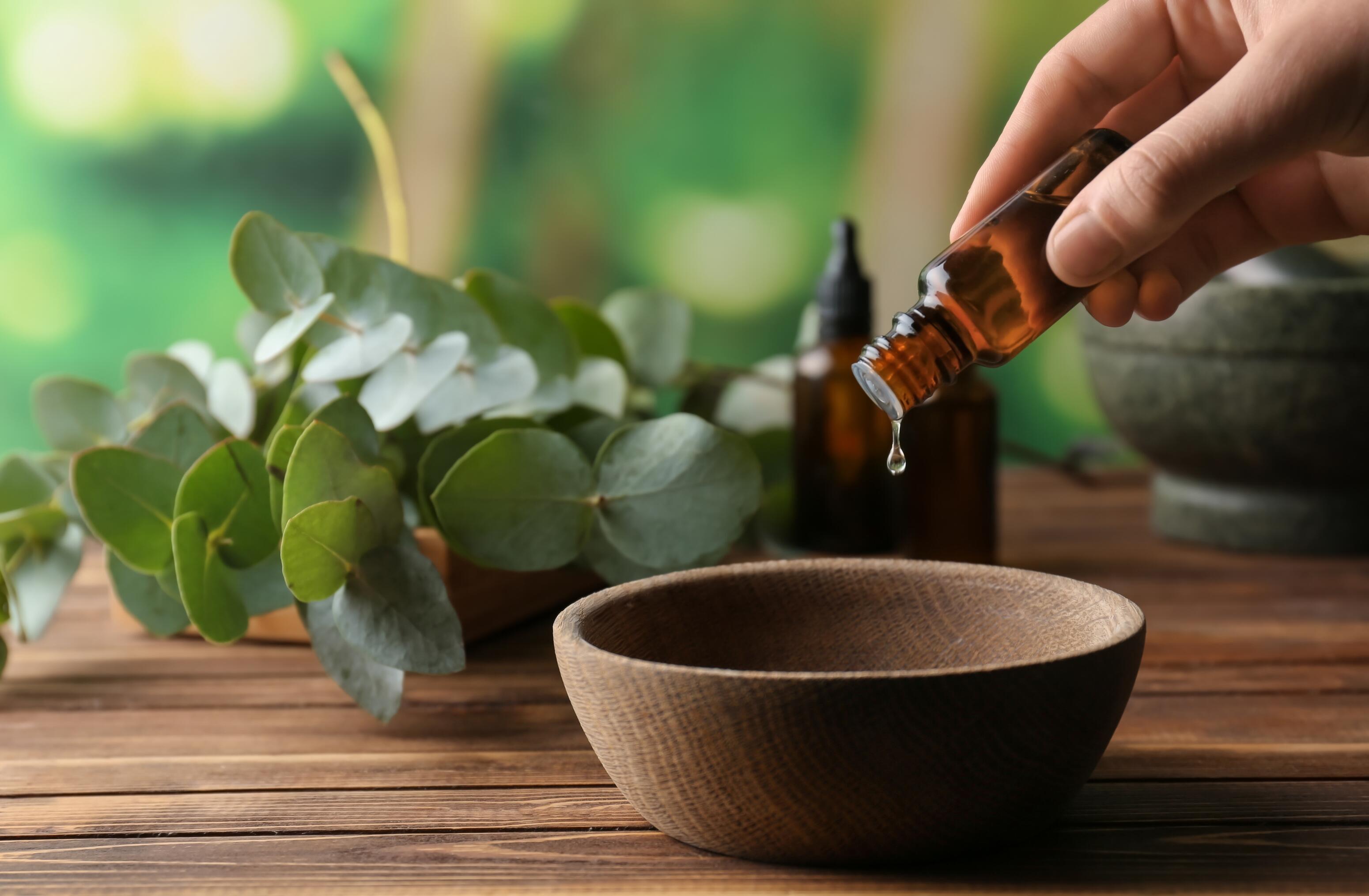
In the case of essential oils for adult acne (or adolescents over 10 years of age), certain essential oils are being studied to assess their potential for treating skin imbalances related to inflammation, bacterial proliferation and skin cell oxidation. Tea tree essential oil (or Melaleuca alternifolia), for example, is one of the most widely documented in clinical trials on acne(2 and 3).
Other essential oils are also mentioned in studies for their molecular composition with cleansing and soothing properties. Among these molecules, the most notable are:
- Terpinen-4-ol(2), the main constituent of tea tree essential oil (Melaleuca alternifolia), regularly cited in acne research.
- Linalool(2), found in true lavender essential oil (Lavandula angustifolia) and rose geranium (Pelargonium graveolens), studied for its action on skin balance.
Available studies suggest that certain essential oils could be a complementary option for treating acne-prone skin(4). Beyond their skin benefits, certain essential oils for acne are also used for their calming effect on the nervous system, helping to manage stress, a factor that can influence your skin’s balance(2).
All essential oils remain highly concentrated extracts. Care must be taken when applying them to the skin: some may be irritating, allergenic or photosensitising. Their use must be adapted to suit your skin type and individual sensitivities. Always seek advice from a healthcare professional before use.
The benefits of essential oils for acne
Certain essential oils are being studied for their potential in treating acne-prone skin, due to their antimicrobial, anti-inflammatory and antioxidant properties. The main advantages researched are as follows:
Antibacterial action
Acne is not simply the result of excessive proliferation of Cutibacterium acnes, but rather from an overall imbalance in the skin microbiota. This imbalance alters the relationship between the skin and naturally occurring bacteria, promoting an excessive inflammatory response(1).
Studies show that certain molecules present in essential oils can limit the activity of bacterial strains linked to acne, while respecting the overall balance of the microbiota. Among those that offer this benefit is tea tree essential oil (Melaleuca alternifolia), which is well documented for its targeted action on C. acnes and Staphylococcus epidermidis. Rosemary verbenone essential oil is also being studied for the same purpose(5 and 6).
Unlike antibiotics, these essential oils that combat acne do not promote the development of bacterial resistance. However, their application method and concentration require caution, as inappropriate use can weaken the skin barrier.
Anti-inflammatory properties
Acne is often accompanied by redness, swelling, and pain. Certain essential oils are known for their soothing and restorative effects on the skin. One example is true lavender essential oil (Lavandula angustifolia)(6).
Application methods
One of the criteria for the effectiveness of essential oils is their application method. Inappropriate use may irritate the skin or make it sensitive. For use in a skincare routine, several options are available:
1. For targeted local application: certain essential oils such as tea tree (Melaleuca alternifolia) or true lavender (Lavandula angustifolia) can be applied pure on an ad hoc basis (one drop on a cotton bud), but only to an isolated spot and in small quantities, avoiding the eye area.
2. For broader application: on the face, essential oils for acne must be diluted in a vegetable oil suitable for blemished skin, such as Nigella vegetable oil(7 and 8) (Nigella sativa) or jojoba (9) (Simmondsia chinensis), to prevent irritation and promote good absorption.
In any case, before using essential oils for acne, inform your doctor and always seek advice from a healthcare professional specialising in aromatherapy.
Precautions and contraindications
Essential oils are not conventional treatments. So, before incorporating an essential oil that tackles acne into your skincare routine, here are some precautions to take:
- Discuss this with your doctor and check that there are no contraindications for you.
- After obtaining your doctor's approval, ask your chemist for advice. It is important to choose 100% pure, natural and chemotype (i.e. with a controlled composition) anti-acne essential oils from recognised laboratories (ideally guaranteeing the traceability of their products and organic certification).
- Check with your chemist regarding the required dilution (essential oils should be diluted in a high-quality vegetable oil).
- Before using it for the first time, it is recommended to apply a drop of diluted essential oil to the crook of your elbow and wait 24 hours to check for any skin reactions (redness, itching, tingling)(10). Important: most essential oils are contraindicated during pregnancy and breastfeeding.
- Never apply essential oil to the eye area, mucous membranes or broken skin.
- Be careful with photosensitising essential oils: citrus essential oils can cause brown spots if exposed to sunlight after application.
- Avoid essential oils known as "dermocaustics", such as oregano, thyme thymol, cinnamon bark and cloves. They are harsh on the skin and can cause burns, even when diluted.
So we cannot stress this enough: always seek advice from a healthcare professional before using essential oils.
Sources :
(1) Heng, A., & Chew, F. (2020). Systematic review of the epidemiology of acne vulgaris. Scientific Reports, 10.
(2) Nurzyńska-Wierdak, R., Pietrasik, D., & Walasek-Janusz, M. (2022). Essential Oils in the Treatment of Various Types of Acne—A Review. Plants, 12.
(3) Pazyar, N., Yaghoobi, R., Bagherani, N., & Kazerouni, A. (2013). A review of applications of tea tree oil in dermatology. International Journal of Dermatology, 52.
(4) Deyno, S., Mtewa, A., Abebe, A., Hymete, A., Makonnen, E., Bazira, J., & Alele, P. (2019). Essential oils as topical anti-infective agents: A systematic review and meta-analysis.. Complementary therapies in medicine, 47, 102224 .
(5) Esmael, A., Hassan, M., Amer, M., Abdelrahman, S., Hamed, A., Abd-Raboh, H., & Foda, M. (2019). Antimicrobial activity of certain natural-based plant oils against the antibiotic-resistant acne bacteria. Saudi Journal of Biological Sciences, 27, 448 - 455.
(6) Bungau, A., Radu, A., Bungău, S., Vesa, C., Ţiț, D., Purza, A., & Endres, L. (2023). Emerging Insights into the Applicability of Essential Oils in the Management of Acne Vulgaris. Molecules, 28.
(7) Soleymani, S., Zargaran, A., Farzaei, M., Iranpanah, A., Heydarpour, F., Najafi, F., & Rahimi, R. (2020). The effect of a hydrogel made by Nigella sativa L. on acne vulgaris: A randomized double‐blind clinical trial. Phytotherapy Research, 34, 3052 - 3062.
(8) Eid, A., Elmarzugi, N., Ayyash, L., Sawafta, M., & Daana, H. (2017). A Review on the Cosmeceutical and External Applications of Nigella sativa. Journal of Tropical Medicine, 2017.
(9) Gad, H., Roberts, A., Hamzi, S., Gad, H., Touiss, I., Altyar, A., Kensara, O., & Ashour, M. (2021). Jojoba Oil: An Updated Comprehensive Review on Chemistry, Pharmaceutical Uses, and Toxicity. Polymers, 13.
(10) Sarkic, A., & Stappen, I. (2018). Essential Oils and Their Single Compounds in Cosmetics—A Critical Review. Cosmetics, 5, 11.
Read also
- Discover Taking the pill to tackle acne
What can you do about acne on a daily basis?
Taking the pill to tackle acne
- Discover Masks to tackle acne
What can you do about acne on a daily basis?
Masks to tackle acne
- Discover Peels for acne
What can you do about acne on a daily basis?
Peels for acne
- Discover Zinc to fight acne
What can you do about acne on a daily basis?
Zinc to fight acne
- Discover Acne and sport
What can you do about acne on a daily basis?
Acne and sport
- Discover What kind of make-up should you use for acne?
What can you do about acne on a daily basis?
What kind of make-up should you use for acne?
- Discover What soap should you use for acne?
What can you do about acne on a daily basis?
What soap should you use for acne?
- Discover Acne and the sun
What can you do about acne on a daily basis?
Acne and the sun
- Discover Diet and acne
What can you do about acne on a daily basis?
Diet and acne
Our targeted solutions for acne
Discover our complete range
- Anti-blemishes cleansing gel face and body
KERACNYL
Anti-blemishes cleansing gel face and bodyCleanses - Helps to get rid of imperfections - Anti-Blemish Cream
KERACNYL PP+
Anti-Blemish CreamAvoids skin marks - Helps to get rid of imperfections - Compensates for the effects of drying treatments


Our skincare routines
Oily or acne-prone skin
- Discover Anti-blemish face care summer routine for adult skin
Anti-blemish face care summer routine for adult skin
Do you have blemish-prone skin as an adult?